


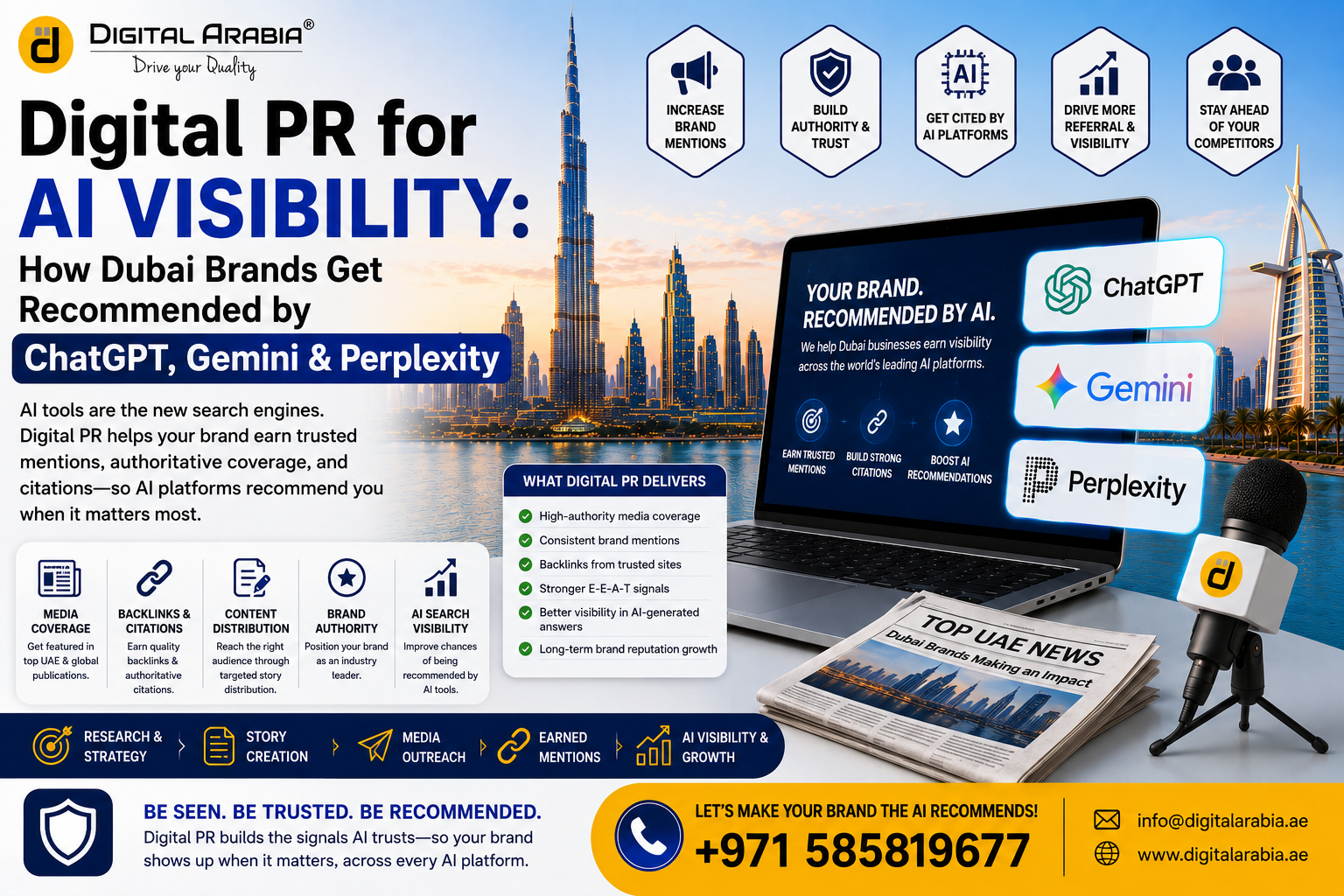
Digital PR for AI visibility is the practice of earning brand mentions, reviews, and citations on trusted third-party websites so that AI assistants – ChatGPT, Gemini, Perplexity, Copilot, and Google’s AI Overviews – name your brand when people ask for recommendations. Your website tells AI who you say you are. The rest of the internet tells AI whether to believe it.
That second part now decides who wins the customer. When someone in Business Bay asks ChatGPT for “the best interior fit-out company in Dubai” or asks Gemini “which clinic in JLT does same-day dental implants,” the assistant doesn’t rank ten blue links. It names two or three brands – and it chooses them based on the web’s collective record: press coverage, reviews, community discussions, directory listings, and independent comparisons. If that record is thin, your brand is invisible at the exact moment a buyer is deciding.
This guide covers why that shift matters for UAE businesses, how AI engines actually pick brands, where they look before naming one, six digital PR tactics that build your record, and how to measure whether any of it is working.
Why AI answers now matter for Dubai businesses
Three numbers explain the urgency. Google’s AI Overviews now appear on more than half of all queries and reach roughly 1.5 billion people a month. ChatGPT alone serves around 900 million weekly users. And AI-referred website sessions grew over 500% in the first half of 2025, according to SparkToro’s analysis – a curve that has kept climbing since.
Dubai amplifies all of this. The UAE has one of the highest smartphone and internet penetration rates in the world, a population that researches almost every purchase online, and an expat majority that arrives with no local brand loyalties – they ask, they compare, and increasingly they ask an AI assistant instead of scrolling search results. A newcomer choosing a moving company, a CFO shortlisting audit firms in DIFC, a family picking a nursery in Mirdif: these are exactly the conversational, “who should I trust” questions AI answers directly.
And AI answers are zero-click by design. If the assistant recommends three of your competitors, the buyer never reaches your website, never sees your portfolio, never fills your form. You didn’t lose the comparison – you were never in it.
How AI assistants decide which brands to recommend
AI engines read far beyond your website to learn about you. A claim on your own site – “leading,” “award-winning,” “trusted by hundreds” – is treated as marketing. The same claim repeated by an independent publication, a review platform, or a community thread is treated as evidence. The more independent sources that corroborate what your site says, the more confidently an AI system can repeat it – and the more likely it is to cite your pages as a source.
The data behind this is striking. Ahrefs analyzed 75,000 brands in late 2025 and found that brand mentions across the web correlate roughly three times more strongly with AI visibility than backlink authority does. YouTube mentions showed the single strongest correlation with AI citations (around 0.74), while classic Domain Rating – the backbone of traditional link-building KPIs – came in weak (around 0.27). Mentions, not just links, are the currency.
There’s a second lesson in the research: only about 11% of domains get cited by both ChatGPT and Google’s AI Overviews for the same query. Each platform draws on different favorite sources. Winning one doesn’t win the others – which is why digital PR, which spreads your brand across many source types at once, outperforms any single-channel play.
Two qualities make a source count in AI’s eyes:
- Independence. A publication or reviewer with no stake in your success is inherently more credible than your own homepage.
- Authority. Established outlets and platforms fact-check, editorialize, and protect their reputations – so AI systems weight their claims more heavily.
Digital PR is simply the discipline of earning presence on sources that have both.
Where AI engines look before naming a UAE brand
Not all third-party mentions carry equal weight, and the sources that matter in Dubai are not identical to the ones that matter in the US. Here’s the map for the UAE market:
| Source type | UAE-relevant examples | Why AI trusts it |
| Reference & entity databases | Wikipedia, Wikidata, Crunchbase, LinkedIn company pages | Structured, fact-checked identity data – the backbone of how AI understands who you are |
| Regional business & news press | Gulf News, Khaleej Times, The National, Arabian Business, Gulf Business, Zawya, Entrepreneur Middle East | Editorial standards and reputational stakes; heavily indexed and cited |
| Review platforms | Google Business Profile, Trustpilot; Clutch & GoodFirms (B2B services); Tripadvisor & Zomato (F&B, hospitality); Bayut & Property Finder (real estate) | Independent, volume-based corroboration of what customers actually experience |
| Communities & forums | Reddit (r/dubai, r/UAE), Quora, niche expat forums | Unfiltered peer recommendations – a favorite source for conversational AI |
| Video | YouTube reviews, walkthroughs, founder interviews, event talks | The strongest single mention signal in current correlation studies |
Platform habits differ, too. Studies of AI citation patterns show ChatGPT leaning heavily on Wikipedia (nearly half of its citations in some analyses) and Reddit; Perplexity leans hardest on Reddit and community discussion; Google’s AI Overviews pull around 92% of citations from pages already ranking in the top ten – meaning traditional SEO in Dubai still underwrites your AI Overview presence even as the other platforms play by different rules.
The practical takeaway: audit which sources AI currently cites for your category. Ask ChatGPT, Gemini, and Perplexity the questions your buyers ask – “best [your category] in Dubai,” “[competitor] alternatives UAE,” “is [your brand] good?” – and note every source they cite. Those pages and platforms are your PR target list.
6 digital PR tactics that build AI visibility for UAE brands
1. Publish UAE-first original data
Regional journalists are hungry for local numbers and short on sources. A brand that publishes a credible UAE dataset – a Dubai SME digital ad-spend survey, a villa renovation cost index, an e-commerce delivery-time benchmark, a salary or fees guide for its niche – gives every outlet in the region a reason to cite it. Each citation adds a link and a mention; the report page itself becomes a URL that AI engines cite directly when users ask data questions in your category.
Design the study around a question your industry argues about, keep the methodology transparent, and publish a clean landing page with the headline findings summarized in the first paragraph. Then pitch it – don’t wait to be found. One well-promoted data story per quarter compounds faster than fifty generic blog posts.
2. Earn coverage in regional business press
Tie your pitches to moments the UAE press already covers: new regulations, GITEX and other trade events, Ramadan and DSF commerce trends, free-zone announcements, funding news. Offer a named expert with a specific, defensible point of view rather than a company plug. Editorial mentions in outlets like Gulf News, Arabian Business, or Zawya do double duty – they build the authoritative record AI reads, and they typically bring a high-authority link that strengthens your site’s own citability. A structured link building programme should treat these editorial placements as its top tier.
One UAE-specific edge most brands ignore: Arabic-language coverage. AI assistants answer Arabic prompts with Arabic sources. If your entire press footprint is in English, you’re invisible to a large share of the market’s queries. Bilingual outreach widens your entity’s record in both languages.
3. Get placed in the “best in Dubai” lists AI already cites
When users ask AI for recommendations, the engines lean on independent roundups and comparison pages – “best clinics in Dubai,” “top fit-out companies UAE,” “[competitor] alternatives.” These third-party lists often get cited multiple times in a single AI answer, while the recommended brands’ own websites get cited zero times. Being on the list matters more than being linked from it.
Run your buyer prompts, collect the roundup URLs that keep appearing, and pitch the publishers directly for inclusion – with genuine differentiators, client evidence, and review proof, not adjectives. One caution: publishing a list on your own domain that crowns yourself #1 doesn’t substitute for independent placement. Its self-interest is exactly what AI discounts – and if the page names competitors, you may hand them the visibility instead.
4. Build review depth where your buyers already talk
Review platforms are how AI cross-checks your positioning against reality. For almost every Dubai business, that starts with your Google Business Profile – volume, recency, and owner responses all shape how assistants describe you, and they feed your local SEO in Dubai at the same time. From there, invest in the platforms your category is judged on: Clutch and GoodFirms for B2B services, Tripadvisor and Zomato for hospitality, Bayut and Property Finder for property, Trustpilot for e-commerce.
Make review generation systematic, not occasional: a post-purchase WhatsApp or email flow, a QR code at the point of service, a follow-up after every completed project. And keep your positioning consistent – the description on your listings should match your website, so AI reads one coherent brand instead of several conflicting ones.
5. Contribute expert commentary journalists can quote
Reporters and content teams constantly need credible specialists. Journalist-request platforms and direct relationships with regional editors put your experts in stories AI later cites – and when an assistant answers a question in your field, a previously quoted expert from your team is exactly the kind of attributed authority it likes to surface.
The bar for getting quoted is specificity. “Digital marketing is important for growth” earns nothing; “UAE service businesses that respond to Google reviews within 48 hours see measurably more inquiry calls – here’s the pattern we see across client accounts” earns the quote. Give numbers, name mechanisms, take a position.
6. Lock down entity clarity – in English and Arabic
AI systems assemble your brand as an entity from every source they can find. If your name, category, founding year, service list, and locations differ between your website, Google Business Profile, LinkedIn, Crunchbase, directories, and press mentions, the entity fragments – and fragmented entities get mentioned less and described worse.
Audit every profile for consistency, add Organization schema with sameAs links connecting your official profiles, publish an llms.txt file that summarizes who you are and your key pages, and confirm your robots.txt allows the AI crawlers you want (GPTBot, OAI-SearchBot, ClaudeBot, PerplexityBot). In the UAE, extend the audit to your Arabic brand rendering: one standardized Arabic name used everywhere, matching your trade licence and your Arabic-language coverage. This technical layer is where digital PR meets technical SEO – and it’s the foundation our generative engine optimization service in Dubai is built on.
How to measure whether your digital PR is moving AI visibility
Placements alone aren’t the KPI. Measure whether AI behavior changes:
1. A fixed prompt portfolio. Build a list of 20-30 real buyer prompts for your category (“best X in Dubai,” “X near Marina,” “[competitor] vs alternatives,” “is [brand] reliable”). Run them monthly across ChatGPT, Gemini, Perplexity, and Copilot. Log whether you’re mentioned, where you appear in the answer, and which sources each answer cites. Track your aggregate share of mentions against named competitors – individual prompts fluctuate too much to mean anything on their own; the portfolio trend is the signal.
2. Citation growth. Note which of your URLs appear as cited sources over time. Your data reports, comparison content, and service pages should start showing up as your PR record deepens. Refresh your most-cited pages every 60-90 days – AI engines visibly prefer fresh sources.
3. AI referral traffic. In GA4, build a segment for referrals from chatgpt.com, perplexity.ai, gemini.google.com, and copilot.microsoft.com. Volumes start small, but these visitors arrive pre-recommended and convert accordingly.
4. Downstream lift. Branded search volume and direct traffic rising alongside your PR activity is the classic signature of recommendation-driven demand – people hear the name from an assistant, then come looking for you.
Establish the baseline before the campaign starts. Without a “before,” you can’t prove the “after.”
Frequently asked questions
Is digital PR for AI visibility the same as link building?
No, though they overlap. Link building targets ranking signals for traditional search; digital PR for AI visibility targets mentions, reviews, and citations – including unlinked ones – because AI engines learn from references, not just hyperlinks. Current research shows brand mentions correlating far more strongly with AI visibility than backlink authority. The best programmes run both, since Google’s AI Overviews still draw overwhelmingly from top-ranking pages.
How long does it take for PR to show up in AI answers?
AI platforms that search the live web (Perplexity, ChatGPT with browsing, AI Overviews) can reflect new coverage within days of indexing. Platforms answering from model memory update more slowly – on model release cycles. Plan for meaningful, stable movement over three to six months, with early signals sooner.
Do Arabic-language mentions actually matter?
Yes. Assistants answering Arabic prompts draw on Arabic sources, and a large share of UAE queries happen in Arabic. Brands with a bilingual press and review footprint are eligible for roughly twice the answer surface of English-only competitors.
Can a small Dubai business afford this?
Yes – the entry points are nearly free. Systematic Google reviews, a consistency audit of your listings, and one genuinely useful local data story will outperform a big retainer spent on generic activity. Budget scales the speed, not the eligibility.
The record decides. Start building yours.
AI assistants trust what the internet says about your brand more than what your homepage says. Digital PR is how you author that record deliberately – regional coverage, deep reviews, independent list placements, quoted expertise, and a clean, bilingual entity – so that when a buyer in Dubai asks an AI who to hire, the answer includes you.
Digital Arabia builds exactly this for UAE brands: the outreach, the review engines, the entity work, and the measurement to prove it’s moving. Request a free AI visibility audit and we’ll show you what ChatGPT, Gemini, and Perplexity say about your brand today – and the fastest route to changing it.