


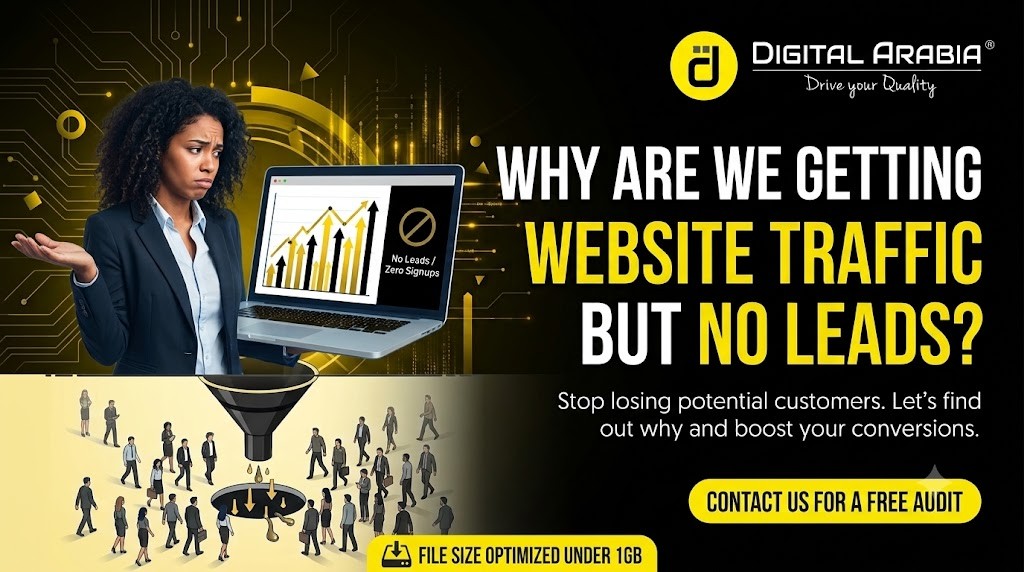
If your website traffic is climbing but your inbox and WhatsApp stay quiet, the problem isn’t traffic — it’s what happens after someone lands on your page. Traffic without leads almost always comes down to one of three gaps: the traffic isn’t the right audience, the landing page doesn’t build enough trust or urgency to act, or there’s no easy next step once someone arrives. Diagnosing which one is actually happening matters more than jumping straight to a tactic, because fixing the wrong gap can waste months of budget while the real leak stays open.
This is one of the most common questions we hear from business owners across Dubai and the wider GCC, and it’s rarely a single-cause problem. Below, we walk through the three most likely reasons, how we test for each one, and what actually moves the needle once you know where the leak is.
Wrong Audience, Right Numbers
A traffic report full of green arrows can hide a very simple problem: the people showing up aren’t the people who buy. High traffic from broad, generic, or poorly targeted keywords looks impressive in a monthly report, but it converts at a fraction of the rate of specific, intent-driven traffic. Someone searching “interior design ideas” is browsing. Someone searching “villa interior designer in Dubai Hills” is closer to hiring one.
Before we touch a single element on the page, we check search intent against what the landing page is actually offering. If a page ranks for informational keywords but is built to sell a service, the mismatch alone can explain a high bounce rate and a near-zero conversion rate — no matter how well-designed the page is. This is also where lead generation strategy and SEO strategy need to be aligned rather than run as two separate efforts, since ranking for the wrong terms simply brings in more of the wrong visitors, faster.
We look at:
- Which keywords are actually driving sessions, and whether they signal buying intent or research intent
- Whether paid and organic traffic are landing on pages built for that specific intent, or a generic homepage
- How traffic quality varies by channel — social, paid search, organic, referral — since each often needs a different landing experience
Once we know the traffic is reasonably qualified, we move to the page itself.
The Page Isn’t Doing Its Job
Even well-targeted traffic will bounce off a page that makes conversion feel like work. A slow load time, a contact form asking for eight fields when two would do, or a call to action buried below three scrolls of copy will quietly kill conversions even when everything upstream — the keyword, the ad, the offer — is right.
We don’t redesign the whole page at once, because that makes it impossible to know what actually caused an improvement. Instead, we test one variable at a time:
- Form length — shorter forms almost always outperform longer ones for initial contact, with qualifying questions saved for a follow-up call
- CTA placement and clarity — a single, obvious action (call, WhatsApp, book a call) usually beats three competing buttons
- Trust signals — reviews, certifications, case studies, and recognisable client logos placed near the point of decision, not just in a footer
- Page speed and mobile experience — a large share of UAE traffic is mobile-first, and a page that loads slowly on a phone loses visitors before they even see the offer
This is also where broader visibility work connects back to conversion. If a business is investing in search engine marketing to drive paid traffic, that budget is only as effective as the landing page it points to — a strong campaign sending clicks to a weak page is the fastest way to inflate cost-per-lead without anyone noticing why.
No Follow-Up System
Sometimes the leak isn’t on the website at all — it’s in what happens in the minutes after someone converts. A lead that isn’t followed up within minutes, not hours, is far less likely to turn into a customer. In competitive markets like real estate, contracting, and healthcare, prospects are often reaching out to two or three providers at once, and the first one to respond usually wins the conversation.
We help set up WhatsApp and email follow-up sequences that run alongside the campaign itself, because the campaign only does half the job — the response is what closes the loop. This includes:
- Instant auto-acknowledgement so the lead knows they’ve been received
- A structured follow-up cadence (same-day call attempt, next-day message, short nurture sequence) rather than a single manual follow-up that depends on someone remembering
- Clear ownership internally, so leads don’t sit unassigned in a shared inbox
When we audit a “traffic but no leads” situation, checking response time and follow-up process is just as important as checking the landing page.
Why It’s Us
Since 2016, we’ve built lead generation systems for 300+ businesses across real estate, contracting, healthcare, and retail in the GCC. That experience is why our approach always starts by tracing the funnel from click to inquiry to close, not just looking at the click. A lot of agencies stop at traffic numbers because traffic is easy to report on. We look further, because traffic was never the actual goal — leads and closed business are.
Frequently Asked Questions
What’s a good conversion rate for a Dubai business website?
Most service-based businesses in the UAE see healthy conversion rates between 2–5% of qualified traffic. E-commerce typically runs lower, around 1–3%. If you’re well below these ranges despite steady traffic, it’s usually a sign of one of the three gaps above rather than a traffic volume problem.
Should we use contact forms or WhatsApp for lead capture?
In the UAE market, WhatsApp often outperforms forms for speed and comfort, especially for higher-value services where people prefer a conversation over filling in a form. We usually recommend offering both, with WhatsApp given equal or greater visual priority on the page.
How quickly can lead flow improve after changes?
Landing page and follow-up fixes can show a difference within 2–4 weeks, since these are structural changes that affect every visitor immediately. Broader traffic quality improvements — better-targeted keywords, refined ad targeting, stronger content — take a full SEO or ad cycle, closer to 8–12 weeks, because search engines and campaigns need time to re-optimise around the new signals
If traffic isn’t turning into inquiries, we can trace the funnel and show you exactly where it’s leaking.