


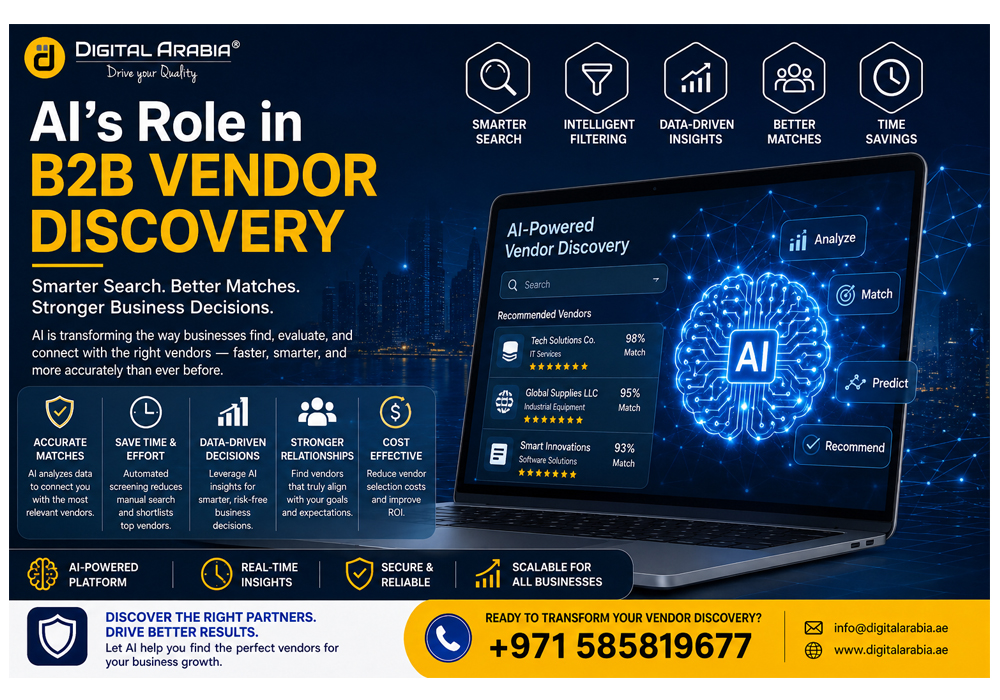
A few years ago, a B2B buying team looking for a new vendor would Google the category, download a couple of analyst reports, browse review sites, and slowly build a shortlist by hand. That process has changed. New industry research on how AI shapes B2B buying shows that AI tools are now woven into nearly every stage of vendor discovery, evaluation, and selection – often before a vendor even knows it is being considered.
For B2B brands across the UAE and wider GCC, this shift matters just as much as it does anywhere else. If your business isn’t visible, described accurately, and easy to compare inside AI-generated answers, you may be filtered out of the shortlist long before your sales team gets a chance to speak with the buyer. Here is what the latest research shows, and what it means for how B2B companies should approach content, SEO, and AI visibility in 2026.
AI Has Become a Daily Habit for B2B Buyers, Not an Experiment
Recent survey data from over 500 U.S. B2B professionals found that the vast majority now use AI tools as part of their regular work routine, with most doing so every single day. This is not occasional curiosity – for a large share of buyers, reaching for an AI assistant has become as automatic as opening a browser tab or checking email.
That habit carries directly into purchasing behavior. Most respondents said they regularly use AI specifically to research vendors and solutions for their job, and nearly all of the remainder said they do so at least occasionally. In other words, the vendor research habit has already formed – the only question left for most B2B brands is whether they show up well inside it.
Where AI Shows Up Across the B2B Buying Journey
One of the more useful findings from this research is that AI isn’t just a top-of-funnel discovery tool – it appears at nearly every stage of the purchase process:
• Early research and category scoping – buyers use AI to understand a problem area before they even know which vendors exist
• Shortlist narrowing – AI is used to cut down a long list of possible vendors to a manageable few
• Active vendor comparison – buyers ask AI tools to compare features, pricing models, and fit directly
• Final decision support – AI is consulted again as buyers close in on a choice
The research also found that AI has a measurable impact at each of these stages: the large majority of buyers say AI has helped them discover vendors they wouldn’t otherwise have found, most say it has materially shaped their shortlist, and a strong majority say it influenced their final vendor decision – with a meaningful share describing that influence as significant. Separate industry data points in the same direction, with buying-cycle research showing shortlists have compressed to just two or three vendor names on average, and AI tools cited as the leading influence on which names make that cut.
Use-Case Fit Beats Brand Recognition
Perhaps the most actionable takeaway for marketers is what actually makes a vendor stand out once it appears in an AI-generated answer. According to the research, buyers pay attention to a vendor mentioned by AI mainly because it closely matches their specific use case, followed by how clear and detailed the description is, and whether it highlights concrete benefits or outcomes. Brand recognition, by contrast, barely factors in – only a small fraction of buyers said they noticed a vendor simply because they recognized the name.
This is genuinely good news for challenger brands and regional players competing against larger, more established names. A lesser-known vendor with precise, well-documented use-case content can outperform a household name in AI-driven recommendations, provided the content clearly answers the buyer’s actual question rather than speaking in generic marketing language.
This also lines up with how buyers prompt AI tools in the first place: most describe their specific use case or problem, ask for direct vendor comparisons, and include constraints such as budget or required features. Vendors whose content mirrors that specificity – clear use-case pages, documented outcomes, transparent pricing signals – are far more likely to be the ones AI surfaces and describes accurately. This is the same content discipline covered in our guide to GEO for UAE businesses: structuring pages so AI systems can find, understand, and cite them correctly.
AI Recommends, But Buyers Still Verify Everywhere Else
Trust in AI-sourced vendor recommendations is high, but it is not blind. Most buyers say they fully or mostly trust what AI tells them about vendors – yet an AI mention is treated as the start of due diligence, not the end of it. After AI surfaces a vendor, buyers commonly go on to visit that vendor’s website directly, search for the company on Google, compare the recommendation against alternatives, and check third-party review platforms before moving forward.
That means a vendor’s website, search presence, and review profile still carry enormous weight. A brand with strong AI visibility but a thin website, weak reviews, or inconsistent search presence risks losing the buyer at the very next step – right after AI has done the hard work of getting that buyer’s attention. As we covered in Digital PR for AI Visibility, the third-party coverage and reviews that back up an AI recommendation matter just as much as the recommendation itself. AI visibility and traditional SEO now have to work together, not as separate disciplines.
The Biggest Risk: Being Invisible, Generic, or Missing Entirely
The frustrations buyers report about AI-generated vendor recommendations point directly at what B2B brands need to fix. The top complaint is that recommendations feel too generic for the buyer’s specific situation, followed by responses that lack depth or accuracy, don’t reflect real pricing or contract structures, or raise credibility concerns. A meaningful share of buyers also say AI missed vendors they already knew were relevant – a direct signal that some legitimate, capable vendors simply are not being picked up by AI systems at all.
For a B2B brand, that combination – thin content, inconsistent pricing signals, and gaps in third-party validation – is what determines whether AI describes you accurately, describes you vaguely, or leaves you out of the conversation altogether.
What This Means for B2B Brands in the UAE and GCC
The shift toward AI-mediated vendor discovery is a global pattern, and B2B companies in Dubai, the wider UAE, and the GCC are operating in exactly the same environment as buyers anywhere else – often while competing for the attention of international buyers evaluating regional vendors alongside global ones. For manufacturing, construction, healthcare, legal, and technology brands targeting corporate and enterprise clients, this changes what ‘being found’ actually requires:
• Content built around specific buyer use cases and problems, not just broad service descriptions
• Clear, well-structured pages that AI systems can accurately summarize and cite
• Consistent, accurate information across your website, directories, and review platforms
• A digital PR and third-party presence strong enough to back up what AI says about you
• Ongoing monitoring of how – and whether – your brand appears in AI-generated answers
How Digital Arabia Helps B2B Brands Win in AI-Driven Vendor Discovery
As a digital marketing agency working with B2B brands across the UAE and Middle East, Digital Arabia builds AI visibility and traditional SEO together rather than treating them as separate projects. That means structuring on-page content around the real questions buyers ask AI tools, strengthening technical SEO so your site is easy for both search engines and AI systems to read, and building the digital PR and review presence that gives buyers confidence once AI has pointed them your way.
If your B2B brand needs to be discoverable, accurately described, and shortlist-ready wherever your buyers are researching – Google, ChatGPT, Gemini, or Perplexity – Digital Arabia’s SEO services in Dubai and B2B marketing teams can help you get there.
Frequently Asked Questions
Is AI really influencing B2B purchase decisions, or just early research?
Research shows AI is involved at every stage – early category research, shortlist narrowing, vendor comparison, and final decision support – not just the initial search.
Does brand recognition still matter in AI-driven vendor discovery?
Less than you’d think. Buyers say use-case fit and clear, detailed descriptions matter far more than recognizing a brand name, which levels the playing field for smaller and newer vendors.
Do buyers still check a vendor’s website after AI recommends it?
Yes. Most buyers treat an AI mention as a starting point and go on to check the vendor’s website, search engines, and review platforms before deciding.
How can a B2B brand improve its visibility in AI tools like ChatGPT and Gemini?
By publishing clear, use-case-specific content, keeping pricing and service information accurate and consistent site-wide, and building third-party validation through reviews and digital PR – the same signals AI systems draw on to describe a vendor.