


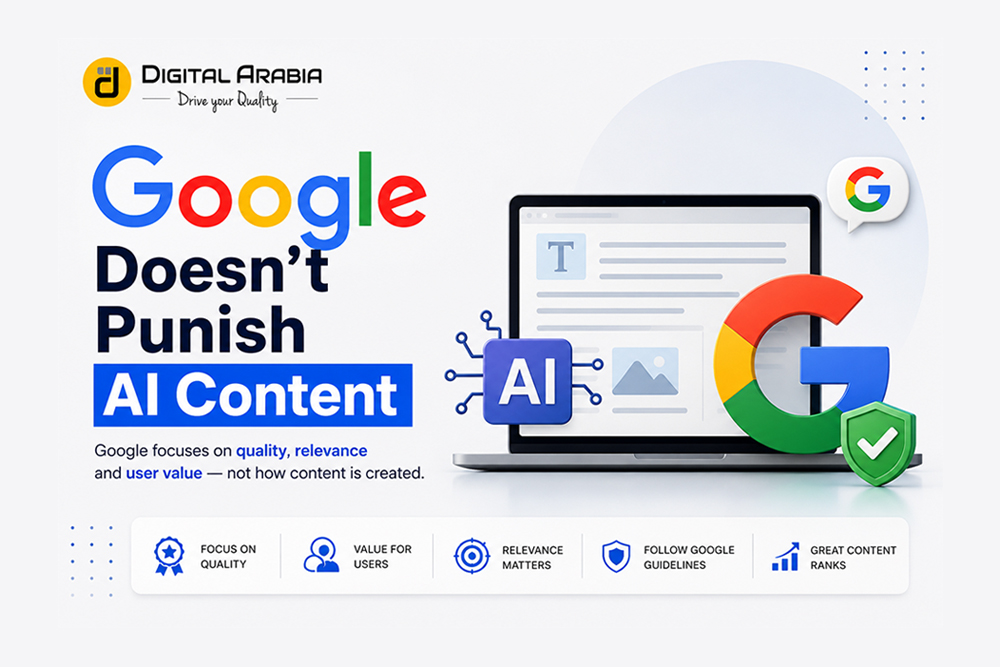
“Will AI content get my website penalized?” is one of the most common questions Dubai business owners ask us before they publish anything. The short answer is no – Google has said clearly, more than once, that content produced with AI assistance is not automatically demoted. What actually gets pages buried is unhelpful, unoriginal, or mass-produced content, regardless of whether a human or a machine typed it.
As a SEO company in Dubai running content programs for clients across healthcare, real estate, e-commerce, and B2B, we see this misconception cost businesses real opportunities. Teams either avoid AI entirely and fall behind on output, or they publish AI drafts with zero editorial oversight and wonder why rankings stall. Neither approach reflects how Google’s systems actually evaluate content in 2026.
What Google Has Actually Said
Google’s own guidance on AI-generated content confirms that its ranking systems reward content based on quality signals, not on the production method. The policy Google enforces against is the same one that has existed for years under its spam guidelines: content created primarily to manipulate search rankings rather than to help people. AI is simply a new, faster way that some sites attempt this – and a new, faster way that legitimate sites can produce genuinely useful material.
In other words, Google’s spam systems target the pattern of low-value, scaled content abuse, not the tool used to write it. A well-researched, fact-checked, expertly reviewed article assisted by AI drafting tools is treated no differently than one typed entirely by hand – because the ranking systems are built to evaluate the output, not the input method.
What Actually Gets Content Penalized
A few patterns reliably trigger Google’s spam and helpful-content systems, and none of them are unique to AI:
- Scaled content abuse: publishing large volumes of pages with little unique value, often to manipulate rankings.
- Content with no real expertise or first-hand experience behind it – generic, interchangeable answers that could apply to any brand in any city.
- Unverified claims, outdated statistics, or factual errors left uncorrected before publishing.
- Content that exists purely to rank rather than to answer a real question a customer has.
Every one of these can happen with fully human-written content, too. A rushed blog post written by an inexperienced freelancer with no fact-checking is just as vulnerable as an unedited AI draft. The common denominator is a lack of editorial rigor, not the presence of AI.
How to Use AI Without Risking Rankings
Our editorial process treats AI as a drafting assistant, never as the final author. In practice, that means:
- Every draft is reviewed and rewritten by a subject-matter-aware editor before publishing.
- Claims, statistics, and pricing are verified against current sources – never left as AI-generated assumptions.
- Content is grounded in the client’s actual services, case studies, and market – not generic filler that could belong to any competitor.
- Pages are built around real search intent and internal linking, not keyword stuffing.
This is the same discipline behind our own technical SEO and content programs, and it’s why our published work – including our recent piece on SEO automation tools – treats automation as a way to work faster, not a shortcut around quality.
The Bigger Shift: AI Is Also Changing How Content Gets Discovered
While businesses worry about AI content getting penalized, the more important shift is happening on the discovery side. AI Overviews, ChatGPT, Gemini, and Perplexity are increasingly the first place customers search – and the same quality signals that protect a page from penalties are what get it cited in these AI answers. We covered this in detail in AI Overviews Are Changing UAE Search Behavior and GEO for UAE Businesses, where we break down how generative engine optimization builds on traditional SEO rather than replacing it.
Well-structured, well-sourced content also earns the kind of third-party mentions that strengthen AI visibility – a topic explored further in Digital PR for AI Visibility. And for B2B brands specifically, our research summary on AI’s Role in B2B Vendor Discovery shows how buyers now use AI tools earlier in the shortlisting process – making credible, well-edited content more important than ever.
The Real Takeaway for Dubai Businesses
AI is not the risk. Unedited, unverified, low-value content is the risk – and it always has been. Businesses that pair AI drafting speed with genuine editorial standards, real expertise, and strong link building and on-page fundamentals will keep ranking well, whether Google’s systems are evaluating traditional search results or AI-generated answers.
If you’re unsure whether your current content strategy meets that bar, our team at Digital Arabia can run a content and technical audit to show you exactly where the gaps are. Explore our full SEO services in Dubai or contact us for a free consultation.