


The Challenge
A Dubai-based client came to Digital Arabia with a familiar problem: a well-built website that search engines simply weren’t rewarding. Traffic had plateaued for over a year, rankings were stuck beyond page two for the keywords that mattered most, and paid ads were carrying almost all new-customer acquisition. The brand needed sustainable, compounding growth – not another short-term traffic spike.
Our team began with a full technical and content audit, the same discovery process outlined in our SEO services in Dubai methodology, to understand exactly where the site was losing visibility.
The Strategy: A Full-Funnel SEO Overhaul
1. Technical Foundation First
Before writing a single blog post, we fixed what was holding the site back. Our technical SEO audit surfaced crawl-budget waste, slow-loading templates, duplicate meta tags, and broken redirect chains. Cleaning these up gave Google a clear, fast path to every important page – the prerequisite for everything that followed.
2. Keyword-Mapped Content Strategy
We mapped commercial, informational, and local-intent keywords to specific URLs, closing gaps where the site had no page competing for high-value searches. Content was built in clusters – pillar pages supported by supporting articles – rather than as disconnected one-off posts, which is central to how we approach local SEO in Dubai for regional service businesses.
3. On-Page Optimization at Scale
Title tags, meta descriptions, header hierarchy, and image alt text were rewritten across the highest-opportunity pages first, then rolled out sitewide. Every page was optimized to answer one clear search intent rather than competing with the client’s own pages.
4. Authority Building
In parallel, our link building team secured relevant, regional backlinks and directory citations, strengthening domain authority so new content could rank faster than it would on content alone.
Internal Linking: The Multiplier Most Sites Ignore
The single highest-leverage change wasn’t new content – it was restructuring how the site’s existing pages linked to one another. A strong internal linking architecture does three things at once: it distributes link equity from high-authority pages toward newer or under-performing ones, it gives Google clear signals about which pages matter most within a topic cluster, and it keeps visitors moving deeper into the site instead of bouncing.
Our internal linking framework for this project included:
• Pillar-to-cluster linking: each core service page linked out to 4-6 supporting blog posts, and every supporting post linked back to the pillar – mirroring how our own SEO packages page anchors its related service pages.
• Contextual in-content links: rather than generic “click here” anchors, links used descriptive, keyword-relevant anchor text placed naturally within the first 2-3 paragraphs, where crawlers and readers both weight them most heavily.
• Orphan-page recovery: the audit identified pages with zero internal inbound links; each was connected into the nearest relevant cluster within a week.
• Fixing link dilution: navigation and footer links were audited to stop over-linking low-priority pages at the expense of revenue-driving ones – the same principle we apply across the service and industries sections of our own site.
• Blog-to-service bridges: every new article closed with a contextual link into the commercial page it supported, turning top-of-funnel content into a direct path toward inquiries – the exact pattern used across our latest blog.
Within 8 weeks of the internal linking rework alone, previously stagnant pages began climbing in rankings – before a single new backlink had been added, confirming that the site’s own architecture had been the bottleneck.
The Results, Month by Month
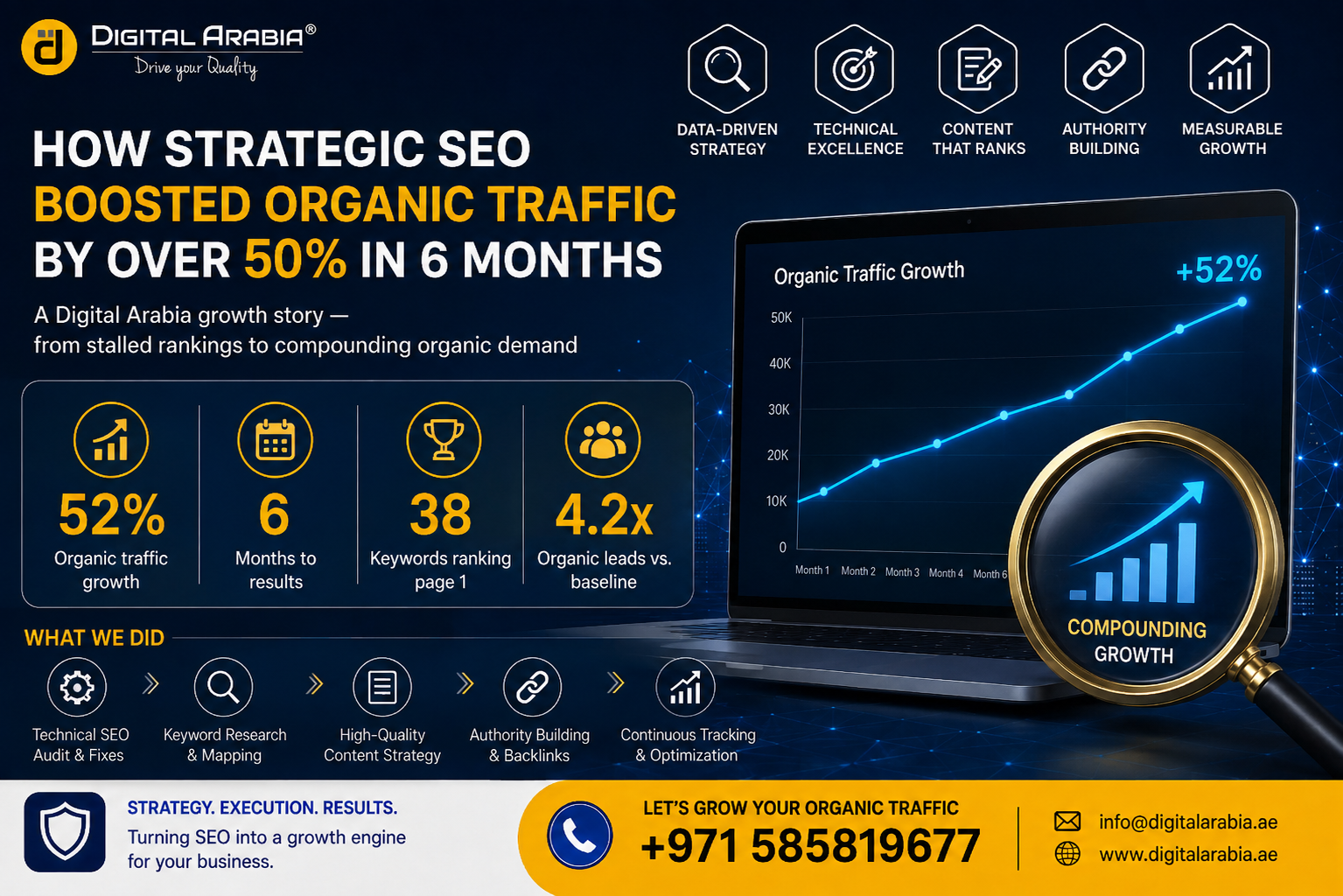
• Months 1-2: technical fixes shipped; indexation and crawl efficiency improved; no visible traffic movement yet.
• Months 3-4: reworked internal linking and the first content clusters pushed multiple pages from page 3+ into the top 20, with organic sessions up roughly 22%.
• Months 5-6: compounding effects from authority building and completed clusters drove organic traffic past the 50% growth mark versus the pre-project baseline, with organic-sourced leads growing even faster than raw traffic.
This pattern is consistent with what Digital Arabia sees across client engagements – our own site reports an average 40% increase in organic traffic across our client base, with individual results varying by starting point, competition, and how quickly technical and internal-linking fixes are implemented.
Why This Approach Works
Traffic gains that come from technical health, intent-matched content, and disciplined internal linking tend to hold – and grow – long after the campaign’s active phase ends, unlike ranking bumps from tactics that fade once effort stops. That durability is the real deliverable: a site structure that keeps compounding on its own.
Ready for Similar Results?
If your site’s traffic has plateaued, the fix is rarely just “more content.” It’s usually a combination of technical health, intent-matched pages, and an internal linking structure that tells search engines – and visitors – where to go next. Request a free strategy consultation or explore our full SEO service offering to see where your site stands today.